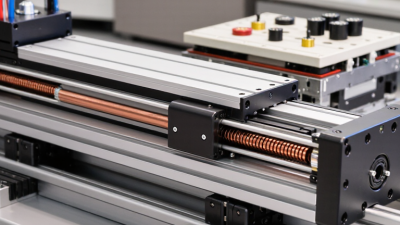
Minimal Space. Maximum Impact! Designed for when every millimeter matters> the new IRONLESS UNANO SERIES
Semiconductors
Increase throughput and precision of your system
Display
Enhance accuracy and precision with linear motors
Science and aerospace
Improve motion quality for a variety of applications
Machine tooling
Robust solutions for increased speed and precision
Digital cutting
Create modular and high throughput applications
Printing
Increase printing speed and quality using linear motors
Robotics
Integrate compact solutions for guaranteed uptime and high dynamics
Life science
Establish precise and clean integrated solutions
Woodworking
Maximize performance and accuracy for high throughput
Stages and system solutions
Compact integration and high performance for your axis
Vacuum applications
Best performance for clean and vacuum applications
Characteristics
Choosing among the top linear servo motor manufacturers worldwide requires more than comparing speed figures. A reliable evaluation begins with application demands, including travel distance, acceleration, positioning accuracy, duty cycle, and installation environment. A motor moving a semiconductor stage needs different qualities from one driving a packaging conveyor.
This guide examines established manufacturers through practical engineering criteria. It considers continuous force, peak force, encoder resolution, thermal management, feedback stability, and controller compatibility. It also reviews manufacturing experience, global service coverage, documentation quality, and replacement support. These factors often determine whether a linear servo motor performs consistently after thousands of operating hours.
Real equipment reveals details that brochures may overlook. Cable routing, magnet-track alignment, bearing preload, and heat near the machine frame can affect accuracy. A cleanroom rating may matter more than maximum acceleration. Service response can matter more than a small purchase-price difference. It depends.
The comparison does not treat one supplier as ideal for every project. A manufacturer with excellent aerospace references may not suit a cost-sensitive assembly line. Likewise, a compact design may create thermal limits during continuous operation. Some published specifications also rely on carefully controlled test conditions. That limitation deserves attention.
Readers will find a balanced framework for comparing leading brands, regional specialists, and application-focused suppliers. The goal is practical confidence, not a simple popularity ranking. Engineers should verify specifications through testing, technical consultation, and representative machine trials before final selection. Small errors here can become expensive downtime later.
Linear servo motors convert electrical energy directly into controlled linear motion. Their key measures are force, speed, acceleration, and positioning accuracy. Continuous force describes thermal capacity, while peak force supports short acceleration bursts. A motor may reach high speed but lose accuracy under changing loads. That trade-off is often missed.
IEC 60034-1:2022 defines rating and performance principles for rotating electrical machines. Linear motor users should apply its thermal and duty concepts carefully, because the standard does not fully describe every linear geometry. Check continuous duty, intermittent duty, insulation, temperature rise, and test conditions. Accuracy also requires separate evidence, including encoder resolution, repeatability, straightness, and machine stiffness. The International Federation of Robotics reported 541,302 industrial robot installations worldwide in 2023, showing why predictable motion performance matters across automated production.
Tips: Compare force at the actual travel speed, not only the catalog peak. Measure heat after a realistic motion cycle. Confirm whether accuracy means resolution or repeatability. These are different. A practical mistake is selecting a motor by force alone. I have seen thermal limits appear only after long cycling. Also, IEC ratings need engineering interpretation for linear systems; treating them as a complete accuracy guarantee is unreliable. A better evaluation includes load inertia, guides, cable drag, ambient temperature, and emergency-stop behavior. Market reports can indicate demand, but laboratory test data should decide suitability.
A useful manufacturer map starts with regional strengths, not a simple global ranking. Europe remains strong in precision engineering, packaging, medical equipment, and factory automation. The International Federation of Robotics reported about 92,000 industrial robots installed in Europe during 2023. That demand supports suppliers offering compact linear servo motors, feedback systems, and high-accuracy stages. Germany, Italy, Switzerland, and neighboring markets often emphasize traceability, thermal stability, and long service intervals.
North America has a different profile. The United States and Canada focus heavily on aerospace, semiconductor equipment, logistics, and flexible production cells. IFR recorded more than 55,000 robot installations in the United States in 2023. Manufacturers serving this region usually compete through application engineering, rapid replacement support, and integration with existing motion platforms. A strong local service network can matter as much as peak thrust. That is easy to underestimate.
Asia-Pacific is the largest production center. IFR reported roughly 383,000 robot installations across Asia in 2023, representing about 70% of global demand. Japan and South Korea remain important for precision motion, while China combines large-scale automation with fast equipment localization. The MarketsandMarkets Motion Control Market report also identifies Asia-Pacific as a leading growth region. Figures vary between reports. The map is imperfect. Buyers should compare continuous force, acceleration, encoder resolution, heat dissipation, and measured repeatability under real loads. Factory tests often reveal differences hidden by catalog specifications. Testing still matters.
Choosing a linear servo motor supplier requires more than comparing catalog numbers.
Performance changes with load, cooling, duty cycle, and mounting orientation. Continuous force shows what the motor can sustain without exceeding its thermal limit. Peak force describes short acceleration events, not normal production output. A reliable benchmark records both values under identical ambient and controller conditions. Otherwise, the comparison is weak.
Speed must be reviewed beside force, because maximum speed often occurs near zero load. Ask for force-speed curves, acceleration data, and regenerative limits. Stroke also matters. A long stroke may reduce usable acceleration or require stricter alignment. Measure settling time at the target position, not only travel speed.
In factory trials, watch temperature rise, vibration, audible noise, and force ripple. These details reveal whether the motor remains stable after repeated cycles. I have seen impressive peak figures become less meaningful after demanding motion continues for several minutes.
Tips: Build a test sheet with the same payload, stroke, cycle rate, and cooling method. Record continuous force, peak force duration, speed, positioning error, and temperature. Request raw test conditions, not just headline specifications. Leave safety margin; real machines rarely behave like laboratory setups.
When comparing linear servo motor manufacturers worldwide, start with measurable feedback performance. Resolution describes the smallest position change the encoder can detect. It does not guarantee accuracy, repeatability, or stable motion. Ask for encoder counts, signal type, calibration records, and error data across the full travel range. A practical test should examine stopping at several positions, not only the center of the rail.
Reality is messier. High resolution can expose vibration, electrical noise, or mechanical backlash. Request sample plots from loaded operation, with temperature and speed clearly recorded. Also check whether the supplier supports your controller and provides replacement feedback components. Clear documentation often reveals more than impressive catalog numbers.
IP ratings deserve equal attention. An IP65 motor may resist dust and water jets, but it is not designed for immersion or aggressive cleaning chemicals. Confirm the rating for the complete assembly, including connectors, cable glands, and moving joints. Ask how sealing changes after repeated cycles. ISO 9001 certification shows a controlled quality system, but it does not prove every motor will meet your application requirements. Review incoming inspection records, traceability methods, corrective-action reports, and final test criteria. A remote audit can help, although it cannot replace testing a production sample under real load.
Supplier comparison framework using verifiable technical, quality, environmental, and service criteria. Performance bands are evaluation benchmarks, not claims about any specific company.
| Evaluation Dimension | What to Compare | Reference or Benchmark | Evidence to Request | Why It Matters | Suggested Weight | Priority |
|---|---|---|---|---|---|---|
| Feedback Resolution | Encoder counts, interpolation, absolute or incremental feedback, and position resolution at the motor or actuator output. | Compare the complete feedback chain rather than encoder counts alone. Confirm whether the stated value is native resolution, interpolated resolution, or repeatable mechanical resolution. | Encoder datasheet, feedback protocol specification, sample position-error report, and test conditions. | Higher usable resolution can improve positioning accuracy, velocity regulation, and low-speed smoothness when the mechanics and control system can support it. | 20% | High |
| Positioning Accuracy | Absolute accuracy, repeatability, bidirectional repeatability, backlash, and straightness of the linear axis. | Require separately stated accuracy and repeatability values. Do not treat encoder resolution as a direct substitute for system accuracy. | Calibration certificate, laser interferometer or equivalent test report, travel length, payload, speed, and temperature conditions. | Determines whether the actuator can meet the application’s dimensional and inspection requirements. | 18% | High |
| Continuous and Peak Force | Continuous force, peak force, duty cycle, acceleration, payload, and force derating at different speeds. | Compare force-speed curves at the required voltage and cooling condition. Peak force should not be used as the continuous operating rating. | Force-speed curve, thermal model, duty-cycle calculation, and application sizing report. | Prevents overheating, loss of performance, and undersizing during repetitive motion. | 15% | High |
| Ingress Protection | Protection against solid particles and water at the motor, connector, feedback device, and complete actuator assembly. | Use IEC 60529 IP ratings. The first digit addresses solids and the second digit addresses water; the rating must apply to the installed configuration. | IP test report or certificate, test configuration, connector details, cable orientation, and installation instructions. | Shows suitability for dust, washdown, coolant, humidity, or other environmental exposure. | 12% | High |
| ISO 9001 Quality System | Whether the manufacturing location operates a certified quality management system and whether the certificate scope covers the supplied product. | ISO 9001 certification should be current, issued by a recognized certification body, and traceable to the actual production site and relevant activities. | Current certificate, certificate number, scope, issuing body, expiration date, and audit status. | Indicates a documented quality-management framework, but it does not by itself guarantee product performance. | 10% | High |
| Thermal Management | Heat dissipation, winding temperature limits, cooling method, ambient-temperature range, and thermal protection. | Compare ratings at the same ambient temperature, mounting orientation, cooling method, and duty cycle. | Thermal test data, motor temperature limits, derating curves, and protection settings. | Thermal behavior directly affects continuous force, service life, and repeatability. | 8% | Medium |
| Mechanical Life and Reliability | Guide or bearing life, moving-part wear, peak acceleration, vibration resistance, and maintenance requirements. | Request life calculations based on the actual load, speed, acceleration, stroke, and duty cycle. Life estimates should state assumptions. | Life calculation, endurance-test summary, bearing specification, vibration test data, and maintenance schedule. | Helps estimate total cost of ownership and reduce unplanned downtime. | 7% | Medium |
| Drive and Feedback Compatibility | Supported servo drives, feedback interfaces, communications protocols, voltage, current, tuning functions, and safety features. | Confirm compatibility with the selected controller and drive. Common interfaces may include serial encoder protocols, analog signals, and industrial Ethernet options. | Electrical interface drawings, motor-drive compatibility list, parameter files, and commissioning guide. | Reduces integration time, commissioning risk, and the need for custom electronics. | 5% | Medium |
| Configuration and Customization | Stroke length, mounting, cable exit, connector type, force rating, feedback option, brake, and environmental configuration. | Assess whether modifications are based on a documented standard platform or require a new design and validation cycle. | Configured drawing, bill of materials, change-control procedure, and sample approval process. | Ensures the supplied unit fits the machine without compromising performance or serviceability. | 3% | Medium |
| Documentation and Traceability | Serial-number traceability, inspection records, calibration data, electrical drawings, firmware revision, and revision control. | Documentation should identify the delivered configuration and the applicable revision of every critical specification. | Inspection report, certificate of conformity, calibration record, serial-number policy, and controlled drawings. | Supports validation, troubleshooting, regulatory audits, and repeat purchasing. | 2% | Medium |

Note: IEC 60529 defines the IP Code for degrees of protection provided by enclosures. ISO 9001 defines requirements for a quality management system; certification alone is not a product-performance certification. Final supplier selection should be based on application-specific testing, verified documentation, and a representative sample.
Linear servo motor manufacturers serving semiconductor, CNC, and robotics markets must prove more than speed. They must demonstrate stable force, thermal control, and repeatable positioning. WSTS forecast global semiconductor sales at 611.2 billion dollars in 2024. That scale increases pressure on wafer tools to reduce vibration and contamination. In cleanroom stages, tiny position errors can become costly yield losses.
CNC systems demand acceleration without sacrificing surface quality. Robotics adds changing payloads, impact risks, and demanding duty cycles. The International Federation of Robotics reported 541,302 industrial robots installed worldwide in 2023. This figure shows why linear motion suppliers need practical integration experience, not only attractive catalog specifications. Engineers should check continuous force, peak force, encoder resolution, cooling method, and serviceability under real production loads.
ISO 13849-1:2023 also changes the conversation. A motor is not a safety system by itself. Designers must evaluate Performance Level, MTTFd, diagnostic coverage, and common-cause failures across the complete control architecture. Independent validation remains essential. A fast actuator can still create an unsafe machine. No selection matrix is perfect. Field testing exposes weaknesses that laboratory data may hide, especially during cable flexing, thermal cycling, and emergency stops. Reliability claims should therefore connect published test methods with traceable maintenance records and application evidence.