| 1 |
Tube and Profile Processing Capability |
15% |
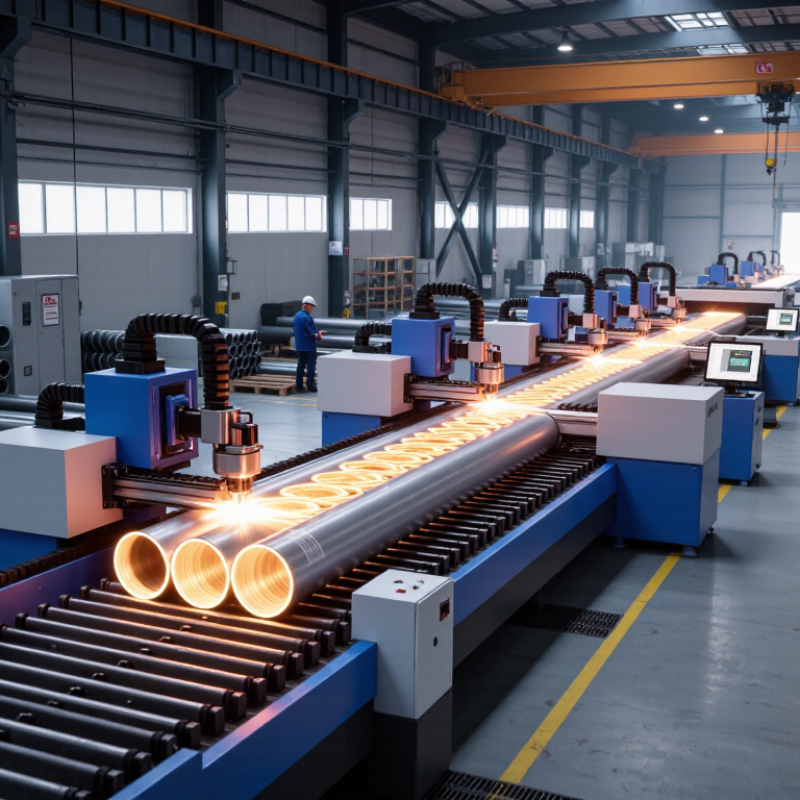
Verify supported round, square, rectangular, channel, angle, and irregular profiles.
Check maximum tube diameter, maximum length, wall thickness, and material compatibility,
including carbon steel, stainless steel, aluminum, brass, and galvanized tube.
|
Machine specification sheet, dimensional drawings, sample-cut report, and a live test using
the buyer’s actual tube dimensions and materials.
|
| 2 |
Laser Source and Cutting Power |
10% |
Compare rated continuous-wave power, wavelength, electrical efficiency, cutting parameters,
duty cycle, and compatibility with the intended material thickness. Higher power should be
assessed together with actual production speed and edge quality.
|
Laser source datasheet, power test record, cutting-parameter database, and an independent
demonstration of the required thickness range.
|
| 3 |
Positioning Accuracy and Repeatability |
12% |
Review declared positioning accuracy, repeatability, axis calibration method, mechanical
transmission design, and thermal compensation. Values should be stated under defined test
conditions rather than presented as unsupported maximum claims.
|
Factory acceptance test, calibration certificate, laser interferometer or ball-bar report,
and repeated sample measurements from several production cycles.
|
| 4 |
Chuck, Clamping, and Profile Stability |
10% |
Evaluate chuck type, clamping range, centering performance, gripping force, anti-slip
control, pneumatic or hydraulic requirements, and the ability to process thin-wall tubes
without deformation.
|
Chuck drawings, clamping-range chart, pressure requirements, deformation test results, and
samples cut from both thin-wall and heavy-wall tubes.
|
| 5 |
Automation and Material Handling |
10% |
Assess loading and unloading automation, raw-material storage compatibility, automatic
centering, remnant handling, barcode or job identification, and integration with conveyors
or production-management systems.
|
Automation cycle-time data, layout drawings, interface specifications, material-handling
video, and a test using representative bundles or individual tubes.
|
| 6 |
CAD/CAM and Tube-Nesting Software |
8% |
Check 3D tube modeling, automatic nesting, common-line cutting, collision avoidance,
remnant management, parametric features, file compatibility, and support for standard CAD
formats such as DXF, DWG, STEP, or IGES where applicable.
|
Software demonstration, sample program files, post-processor test, user-access control
details, update policy, and operator training materials.
|
| 7 |
Safety and Regulatory Compliance |
10% |
Verify enclosed beam protection, interlocked access doors, emergency stops, warning
indicators, fume extraction, fire-risk controls, electrical protection, and documented
risk assessment. Applicable requirements depend on the destination market.
|
Risk-assessment file, electrical schematic, safety-circuit validation, conformity
documentation, guarding inspection, and applicable third-party certification.
|
| 8 |
Productivity, Energy Use, and Operating Cost |
10% |
Compare cutting speed, acceleration, piercing time, idle time, average power consumption,
assist-gas consumption, consumable life, scrap rate, and expected uptime. Productivity
should be calculated from complete production cycles rather than cutting speed alone.
|
Time-study report, energy-meter readings, assist-gas consumption records, consumable-cost
list, and a multi-part production trial.
|
| 9 |
After-Sales Service and Spare Parts |
8% |
Review installation support, commissioning time, remote diagnostics, response-time
commitments, technician availability, spare-parts lead times, warranty coverage, and
preventive-maintenance procedures.
|
Written service-level agreement, warranty terms, spare-parts catalog, maintenance schedule,
training plan, and references from comparable industrial users.
|
| 10 |
Documentation, Quality Control, and Total Value |
7% |
Evaluate manufacturing traceability, inspection records, assembly standards, machine
documentation, operator manuals, training quality, delivery schedule, payment terms, and
total cost of ownership over the planned service life.
|
Quality-control plan, inspection checklist, serial-number traceability, complete manual
package, acceptance criteria, commercial quotation, and lifecycle-cost comparison.
|