Minimal Space. Maximum Impact! Designed for when every millimeter matters> the new IRONLESS UNANO SERIES
Semiconductors
Increase throughput and precision of your system
Display
Enhance accuracy and precision with linear motors
Science and aerospace
Improve motion quality for a variety of applications
Machine tooling
Robust solutions for increased speed and precision
Digital cutting
Create modular and high throughput applications
Printing
Increase printing speed and quality using linear motors
Robotics
Integrate compact solutions for guaranteed uptime and high dynamics
Life science
Establish precise and clean integrated solutions
Woodworking
Maximize performance and accuracy for high throughput
Stages and system solutions
Compact integration and high performance for your axis
Vacuum applications
Best performance for clean and vacuum applications
Characteristics
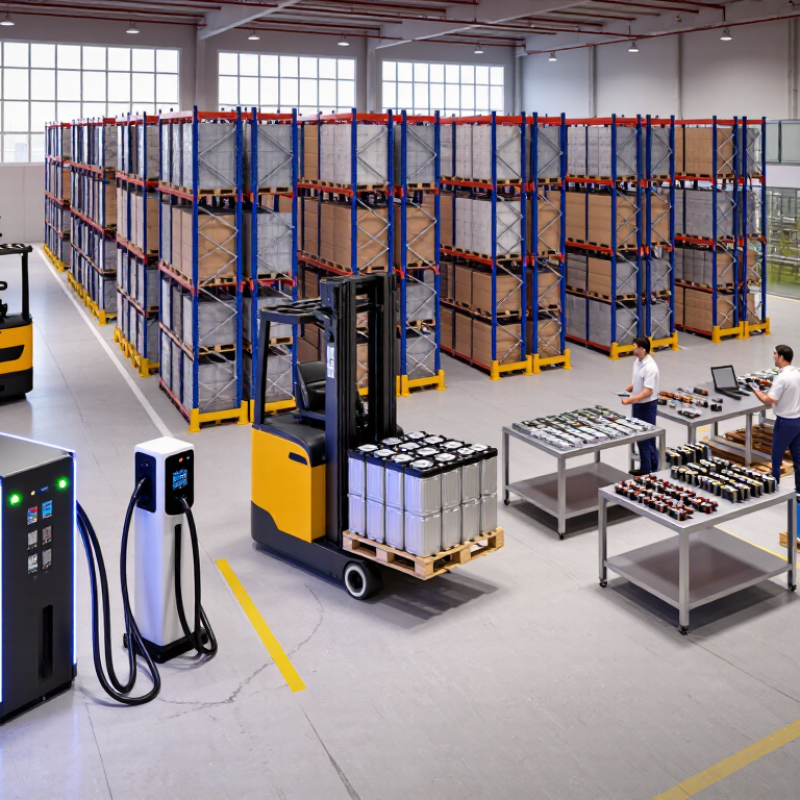
Choosing the best Electric Forklift Battery manufacturer in China requires more than comparing prices or factory photographs. Battery performance affects every warehouse movement, from a loaded pallet entering a narrow aisle to a truck returning for a short charging session. Buyers should examine cell chemistry, usable capacity, cycle life, charging efficiency, thermal control, warranty terms, and after-sales support.
Industry data supports this shift toward careful evaluation. The World Industrial Truck Statistics reports consistently show strong demand for electric industrial trucks across major markets. MHI’s 2024 Industry Report also identifies electrification, automation, and energy management as important material-handling priorities. Meanwhile, the International Energy Agency’s Global EV Outlook 2024 highlights continuing improvements in battery manufacturing scale and cost efficiency. These reports do not identify one universal winner. They reveal a changing market.
Chinese manufacturers now offer lead-acid, lithium-ion, and lithium iron phosphate solutions for warehouses, ports, factories, and cold-storage facilities. However, product brochures can hide practical differences. A battery rated for eight hours may deliver less under heavy loads, steep ramps, or low temperatures. Charging speed may also depend on the truck’s battery-management system and site electrical capacity.
A reliable comparison should include factory audits, sample testing, safety documentation, and customer references. It should also consider local service response time. A low purchase price is not always low operating cost. No ranking is perfect. Even experienced buyers can overlook software compatibility or replacement-part availability. This guide examines leading Chinese manufacturers through measurable performance, manufacturing capability, safety practices, export experience, and long-term service value.
A strong electric forklift battery manufacturer combines proven engineering with practical factory experience. The best suppliers understand warehouse heat, cold storage, dust, charging habits, and demanding shift schedules.
They should provide clear technical data, including voltage, capacity, cycle life, charging time, and operating temperature. Independent test records and traceable production standards make these claims more reliable.
Consistency matters. A professional manufacturer checks cells, welding points, insulation, battery management systems, and final performance before shipment.
They also offer suitable battery designs for different forklift models and working conditions. Responsive technical support is essential when a battery loses capacity unexpectedly. Small delays can stop an entire loading operation.
Tips: Ask for sample test results, warranty conditions, service response times, and maintenance guidance. Check whether the supplier can explain safety protections in simple language. Visit the production facility when possible.
A trustworthy manufacturer does not promise unrealistic cycle life or instant savings. Real performance depends on charging discipline, ambient temperature, load weight, and daily usage.
I have found that honest suppliers discuss these limits early. That conversation may feel less impressive, but it prevents costly misunderstandings.
Some manufacturers still provide attractive specifications without enough field evidence. That weakness deserves careful questioning. Look for documented inspections, trained engineers, stable component sourcing, and after-sales records from comparable warehouse environments.
China’s electric forklift battery manufacturers produce several chemistries for warehouses, factories, and outdoor yards. Lead-acid batteries remain common because they are familiar, repairable, and relatively economical. Typical packs use 24, 36, 48, or 80 volts, depending on the forklift’s lifting capacity and duty cycle.
Flooded lead-acid batteries require scheduled watering, ventilation, and equalization charging. Operators may notice reduced power near the end of a shift. Absorbed glass mat batteries reduce maintenance, but their charging requirements remain strict. Lithium-ion batteries, especially lithium iron phosphate packs, are increasingly selected for multi-shift operations. They support opportunity charging during short breaks and usually provide steadier voltage. Integrated battery management systems monitor temperature, current, and cell balance.
Some Chinese factories also make nickel-metal hydride batteries, although they are less common in modern forklift fleets. Battery choice should match the truck, charger, working temperature, and daily operating pattern. A lithium pack may lower labor costs, yet its purchase price and charger compatibility need careful review. Lead-acid can still perform well in a single-shift warehouse with disciplined maintenance. That detail is often overlooked.
In practical purchasing checks inspect terminal protection, enclosure strength, connector quality, and service documentation. Ask for cycle-test records and operating limits, not only capacity figures. Cold storage can reduce available energy, while heavy loads increase heat and voltage drop. Specifications can look excellent on paper. Real site conditions may disagree.
China Best Electric Forklift Battery Manufacturers?
Chinese electric forklift battery manufacturers serve different operating needs rather than one universal market. Some specialize in lithium iron phosphate battery packs for warehouses, factories, and distribution centers. These systems offer stable voltage, quick opportunity charging, and reduced daily maintenance. Others focus on lead-acid traction batteries, valued for lower purchase costs and familiar servicing methods. Their product ranges often cover 24V, 36V, 48V, 72V, and 80V forklift applications.
Several manufacturers concentrate on battery management systems and fleet monitoring. Their packs can record temperature, charging cycles, current, and fault warnings. This helps operators identify overheating or unusual energy loss before a shift is interrupted. Cold-storage specialists add insulated housings and low-temperature charging controls. Heavy-duty suppliers develop reinforced cases for ports, construction yards, and multi-shift factories. Custom battery dimensions are also common when a forklift uses a narrow compartment.
In practical testing, discharge consistency matters more than a polished brochure. A battery may promise long runtime but perform differently under heavy lifting or winter conditions. I would inspect cell balancing, charger compatibility, warranty coverage, and replacement-part access. Some suppliers communicate technical data clearly. Others leave important details unclear, which deserves caution. Chinese production is broad and improving, but quality still varies between factories, production batches, and service teams. A sample trial remains sensible before a large fleet purchase.
Chinese manufacturers commonly supply lead-acid, lithium iron phosphate (LiFePO₄), and lithium titanate batteries for electric forklifts. The chart compares their typical cycle life at approximately 80% depth of discharge, a key indicator of battery durability.
Reference values are industry-typical figures and vary according to cell quality, battery management systems, operating temperature, charging method, and maintenance conditions.
When comparing Chinese electric forklift battery manufacturers, judge quality through measurable evidence, not showroom claims. Request capacity-test records, cycle-life data, cell traceability, and battery-management-system logs. Check whether rated capacity remains stable after repeated charging. A battery that looks cheaper may lose working hours quickly. Ask for test conditions, because “long life” means little without temperature, load, and charging details.
Safety requires more than a certification logo. Review compliance with relevant powered-industrial-truck standards, including ISO 3691-1 and NFPA 505 guidance. Examine protection against overcharge, short circuits, water, impact, and thermal events. The International Energy Agency reported that global battery demand exceeded 750 GWh in 2023. More production does not automatically mean better control. Inspect factory quality procedures, incoming-cell testing, and fire-response training. Small details matter.
Cost should be calculated as total cost of ownership. BloombergNEF reported an average lithium-ion pack price of 139 US dollars per kWh in 2023, after a 14% annual decline. That figure does not include chargers, installation, spare parts, or downtime. Compare energy efficiency, expected cycles, warranty exclusions, and replacement pricing. After-sales support should include remote diagnostics, local technicians, response-time commitments, and available spare modules. Ask for two customer references. Then verify them independently. A perfect warranty may still fail in practice. Companies should publish failure rates, but many do not. That gap deserves careful attention.
| Evaluation Dimension | Measurable Criterion | Practical Benchmark | What to Verify Before Purchase | Suggested Weight |
|---|---|---|---|---|
| Battery Chemistry | Battery type and operating characteristics | Lead-acid for lower initial cost; lithium-ion, commonly LFP, for frequent or multi-shift operation | Technical datasheet, cell chemistry declaration, operating-temperature range, and application recommendation | 5% |
| Rated Voltage | Nominal system voltage compatibility | Common forklift systems include 24 V, 36 V, 48 V, 72 V, and 80 V | Forklift nameplate, connector configuration, charger output, and battery dimensional drawing | 8% |
| Capacity | Rated energy or ampere-hour capacity | Capacity must meet the truck manufacturer's specified range and the required duty cycle | Capacity test conditions, discharge rate, end-of-discharge voltage, and independent test report | 8% |
| Usable Energy | Energy available during normal operation | Compare usable kWh, not only nominal Ah; allowable depth of discharge must be clearly stated | Usable-energy calculation, discharge curve, depth-of-discharge limit, and battery-management-system settings | 7% |
| Cycle Life | Number of charge-discharge cycles until stated remaining capacity | Lithium-ion cycle-life claims should specify test conditions and remaining-capacity threshold; lead-acid life depends strongly on depth of discharge and maintenance | Cycle-test report stating load profile, temperature, charging method, depth of discharge, and end-of-life capacity, commonly 80% | 10% |
| Energy Efficiency | Charge and discharge efficiency | Compare complete system efficiency, including charger and battery, rather than battery efficiency alone | Measured input and output energy, charger efficiency data, regenerative-braking compatibility, and test conditions | 6% |
| Safety Certification | Electrical, mechanical, and battery safety compliance | Relevant documentation may include IEC 60254 for traction batteries, IEC 62619 for industrial lithium secondary cells, and applicable forklift safety requirements | Valid certificates, test reports, certification scope, model numbers, and issuing laboratory details | 12% |
| Transport Compliance | Requirements for shipping rechargeable lithium batteries | Lithium batteries offered for transport should have applicable UN 38.3 test evidence and correctly prepared transport documentation | UN 38.3 test summary, safety data sheet, packaging specification, labels, and dangerous-goods shipping procedure | 5% |
| Battery Management System | Monitoring and protection functions | Overcharge, over-discharge, over-temperature, over-current, short-circuit, cell balancing, and fault logging should be covered | BMS protection thresholds, communication protocol, event log, firmware-control procedure, and diagnostic software demonstration | 10% |
| Thermal Management | Temperature monitoring and heat control | Temperature sensors should monitor cells or modules; charging and discharging limits must be defined for the intended environment | Sensor layout, thermal test data, low-temperature charging controls, ventilation requirements, and emergency shutdown logic | 6% |
| Mechanical Fit | Dimensions, mass, mounting, and connector compatibility | Battery dimensions, center of gravity, lifting points, and total mass must remain within the forklift manufacturer's limits | Certified dimensional drawing, weight tolerance, center-of-gravity data, connector pinout, and fit-test record | 7% |
| Charging System | Charger compatibility and charging time | Charging current, voltage profile, communication method, and charging time must match the battery chemistry and BMS | Approved charger list, charging curve, estimated time from 10% to 100%, interlock behavior, and installation requirements | 6% |
| Total Cost of Ownership | Lifecycle cost rather than purchase price alone | Include battery, charger, installation, energy, maintenance, spare parts, downtime, replacement, and recycling costs | Five-year or expected-life cost model using duty-cycle data, electricity rates, labor costs, warranty assumptions, and replacement intervals | 8% |
| Warranty Coverage | Warranty period, capacity retention, and exclusions | Warranty should state time, operating hours or cycles, minimum remaining capacity, and permitted operating conditions | Signed warranty document, claim process, exclusions, response time, freight responsibility, and pro-rata provisions | 5% |
| After-Sales Support | Technical response, spare parts, and service capability | Defined response times, remote diagnostics, local service coverage, and documented replacement-parts availability | Service-level agreement, support contact details, technician qualifications, spare-parts lead time, and escalation procedure | 7% |
Choosing a Chinese forklift battery supplier starts with the machine, not a search ranking. Record voltage, capacity, tray dimensions, connector type, duty hours, and charging method. A warehouse using 48V lithium packs needs different thermal controls from a 24V lead-acid truck. Ask the supplier to explain its cell selection, battery management system, charger compatibility, and protection settings in plain language. Good technical answers include numbers, test conditions, and limits. Vague promises are warning signs.
Request factory evidence before discussing volume pricing. Review production photos, serial tracking, incoming cell inspection, welding records, and end-of-line test sheets. Check whether the quoted cycle life uses a defined depth of discharge and temperature. It matters. Ask for samples, then measure runtime, charging temperature, voltage balance, and fit inside the truck. A sample that performs well for one shift may fail during cold storage or multi-shift work. That uncomfortable possibility deserves a written test plan.
Evaluate support as carefully as hardware. Confirm warranty coverage, spare-part availability, response times, remote diagnostics, and training for local technicians. Request references from similar warehouses, not unrelated vehicles. Verify export documents and compliance reports for your destination market through qualified professionals. Do not select the cheapest quote automatically; calculate energy use, downtime, maintenance, and replacement cost. No supplier is perfect, and early sourcing comparisons can trust polished documents too quickly. Independent inspection and a small pilot order can expose weaknesses before they become expensive operational problems.