What is a Photoelectric Sensor and How Does It Work?
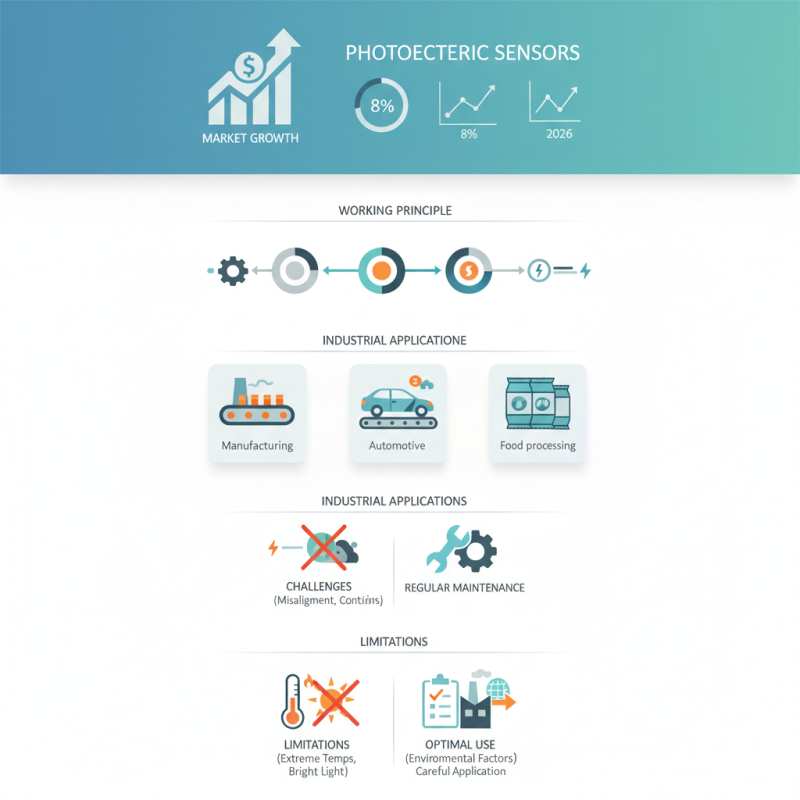
Photoelectric Sensors are increasingly important in modern industrial applications. According to recent industry reports, the global photoelectric sensor market is projected to reach $3 billion by 2026, growing at a compound annual growth rate (CAGR) of 8%. This growth reflects the increasing demand for automation across various sectors. Industries like manufacturing, automotive, and food processing heavily rely on these sensors for precise measurement and control.
The working principle of photoelectric sensors involves detecting objects by emitting and receiving light signals. When an object interrupts the light beam, the sensor detects the change. However, not all installations are seamless. Factors such as dirt, dust, or misalignment can impact sensor efficiency. Regular maintenance becomes essential to ensure accuracy and reliability.
Despite their advantages, there are challenges with photoelectric sensors. Sometimes, they may not work well in certain conditions, such as extreme temperatures or bright light. Understanding these limitations is crucial. Sensor selection must consider environmental factors to optimize performance and minimize errors. Overall, photoelectric sensors offer significant benefits, but careful application is necessary for success.
Definition and Overview of Photoelectric Sensors
A photoelectric sensor is a valuable device that detects objects or changes in the environment. It relies on light to perform its tasks. By emitting a beam of light, it can sense interruptions or reflections. These sensors are widely used in factories, security systems, and automation.
Photoelectric sensors operate based on three main principles: through-beam, retro-reflective, and diffuse reflection. In through-beam mode, a sender and receiver are aligned directly. Retro-reflective mode uses a reflector to bounce the light back to the sensor. Diffuse reflection mode allows the sensor to detect objects within a specific range without needing to be directly aligned.
**Tips:** When installing a photoelectric sensor, consider the environment. Dust or moisture can affect performance. Ensure that the beam is unobstructed for accurate detection. Regular maintenance is crucial. Check for any dirt on the sensor lens to avoid false readings.
In some situations, you might notice that false triggers occur. This can be due to changes in light levels or surrounding objects. Testing sensor sensitivity is essential for reliability. Adjust the settings based on your specific application needs. Observing the sensor's behavior over time can lead to valuable insights.
Types of Photoelectric Sensors and Their Applications
Photoelectric sensors come in various types, each serving unique applications. The most common types are through-beam, retro-reflective, and diffuse sensors. Through-beam sensors consist of a light emitter and a receiver. When an object interrupts the light beam, it triggers a response. These sensors excel in detecting objects over long distances. However, they can struggle with environmental interference.
Retro-reflective sensors use a mirror to bounce light back to the receiver. This design allows for easier setup since the emitter and receiver can be closer. They are effective for detecting shiny surfaces but can be less reliable in dusty environments. Diffuse sensors, on the other hand, do not require reflectors. They detect objects based on how light scatters off the object surface. While they are versatile, their range is limited, making them suitable for close-range applications.
Understanding each type aids in proper selection for specific conditions. Reflection and interference are common challenges. Evaluating the installation environment is crucial. Choosing the right sensor can improve performance but requires careful consideration.
What is a Photoelectric Sensor and How Does It Work? - Types of Photoelectric Sensors and Their Applications
| Type of Sensor | Working Principle | Applications | Detection Range |
| Through-beam Sensor | Emits a beam of light from the emitter to the receiver. | Object detection, counting, and safety applications. | Up to 30 meters or more. |
| Retroreflective Sensor | Uses a reflective surface to bounce back light. | Packaging machinery, conveyor systems. | Up to 15 meters. |
| Diffuse Reflective Sensor | Detects light reflected off the object being sensed. | Material detection, presence sensing. | Up to 2 meters. |
| Fiber Optic Sensor | Utilizes fiber optics for sensing in tight spaces. | Automated inspection, robotics. | Varies; can be very short to several meters. |
Key Components and Working Principles of Photoelectric Sensors
Photoelectric sensors are crucial in various automation processes. They detect objects and record their presence by using light. A typical sensor consists of a light source, usually a laser or LED, and a receiver. When an object interrupts the light beam, the sensor is activated. This interruption is what triggers the response in the connected system.
The working principle is simple. The light emitted travels until it hits an object. It then reflects back to the receiver. If the light does not reach the receiver, it signals that there is an obstacle present. Accurately calibrating the sensor is vital. It can be easy to misalign the light path during installation, leading to missed detections. This misalignment can disrupt operations. Regular checks help maintain optimal performance, but it’s often overlooked.
Another important aspect is the sensor's environment. Dust or fog can interfere with the light signal. This limitation raises questions about their reliability in challenging conditions. While photoelectric sensors are efficient, they are not foolproof. Increased awareness of their strengths and weaknesses can lead to better applications.
Factors Affecting Performance and Sensing Range
When discussing photoelectric sensors, several factors impact their performance and sensing range. Environmental conditions play a significant role. For instance, dust, moisture, and extreme temperatures can affect reading accuracy. In harsh environments, sensors may struggle to detect objects clearly.
The distance between the photoelectric sensor and the object being detected also matters. Greater distances require more powerful sensors to maintain reliability. Reflectivity of the object is another concern. A shiny or dark surface can distort the readings. Additionally, sensor alignment is crucial. Misalignment may lead to poor detection. Regular checks or adjustments could help.
Finally, sensor technology types contribute to variability in performance. Certain sensors are best for specific applications. Choosing the right type is essential. However, this process can be complicated. There’s no one-size-fits-all solution. Ultimately, understanding these various factors can enhance sensor effectiveness.
Common Applications in Industries and Automation
Photoelectric sensors are essential in many industries and automation processes. They convert light signals into electrical signals, enabling precise detection of objects. These sensors are widely used in manufacturing, logistics, and packaging. According to industry reports, the global photoelectric sensor market is expected to grow at a CAGR of 8.5% from 2023 to 2030. This growth highlights the increasing demand for automation and efficiency in various sectors.
In manufacturing, photoelectric sensors play a key role in material handling. They detect the presence or absence of items on conveyor belts. This automation reduces human error and speeds up production lines. Similarly, in logistics, they help in tracking packages and optimizing warehouse operations. These sensors streamline processes but also require regular maintenance to ensure accuracy. A failure in detection can lead to operational delays.
**Tip:** Regularly inspect and clean photoelectric sensors to prevent false readings. Dirty lenses can affect performance.
In packaging lines, photoelectric sensors ensure the correct placement of items in boxes. They activate mechanisms that seal or cut packaging. However, misalignment can lead to product waste. Training staff to understand sensor limits is crucial for maintaining efficiency.
**Tip:** Implement a feedback loop for sensor performance. Regularly analyze data to identify patterns of failure or malfunction.
Photoelectric Sensor Applications in Different Industries