What Is the Best FRP Rectangular Tube in 2026?
Choosing the best Frp Rectangular Tube in 2026 is not a matter of picking the thickest wall or the lowest price. A profile must suit its actual load, span, environment, and installation method. A tube supporting a light access platform faces different demands from one used in a corrosive processing area. Details matter.
Before comparing products, check the resin system, fiber orientation, dimensions, tolerances, and published mechanical data. Ask whether test results apply to the exact profile and conditions you plan to use. A broad “high strength” claim tells you little without a test method or design context. Confirm how the tube will be cut, drilled, joined, and supported; small installation choices can affect performance.
Composite materials researcher Dr. Stephen W. Tsai is a relevant expert in composite design, but no source material was provided for a verified quotation from him. Rather than invent one, this guide uses a practical design question: “Does this profile meet the required load, environment, and service life?” Treat that as an editorial question, not a quotation. It captures the decision more reliably than a slogan.
The comparison ahead examines strength, stiffness, corrosion resistance, weight, fabrication, and cost. It also considers where supplier documentation leaves unanswered questions. A product may look ideal on a specification sheet and still prove awkward to assemble. Not just strength. The best choice is the one supported by suitable data and matched to real operating conditions.
What Is an FRP Rectangular Tube?
What Is the Best FRP Rectangular Tube in 2026?
What Is an FRP Rectangular Tube?
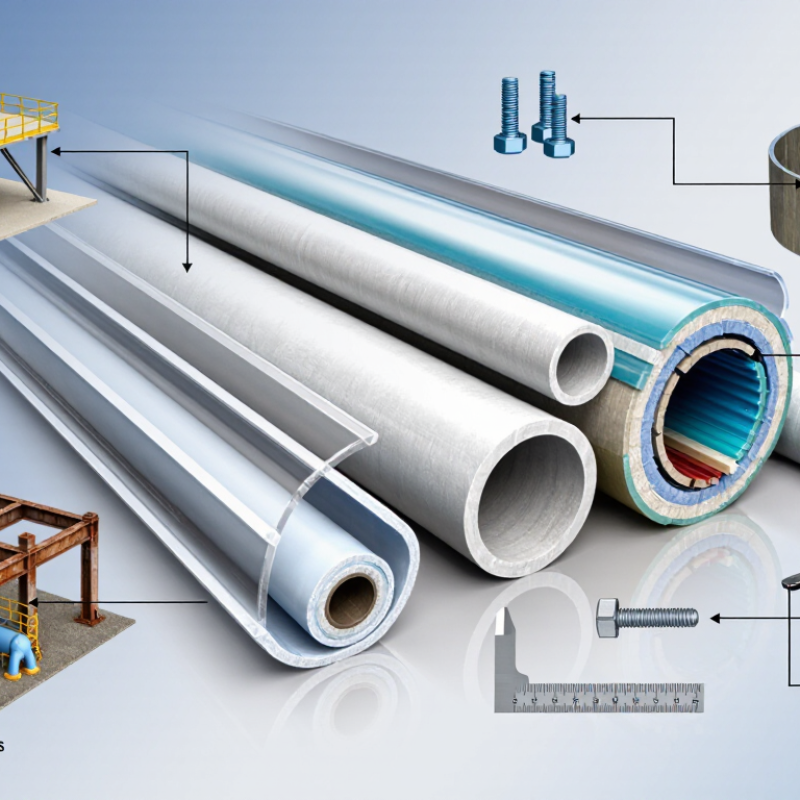
An FRP rectangular tube is a hollow profile made from fiber-reinforced polymer, usually glass fibers embedded in a resin. Many are manufactured by pultrusion, which pulls continuous fibers through resin and a heated shaping die. The result is a lightweight tube with flat sides and a rectangular opening. That shape matters. Flat faces make it easier to connect panels, brackets, and other structural parts.
Unlike steel, FRP does not have the same strength in every direction. Its performance depends partly on how the fibers are arranged and on the loads applied. This detail is easy to overlook. A tube that handles bending well along one axis may perform differently when loaded from another direction. Check product data for dimensions, wall thickness, load ratings, and test conditions.
FRP tubes are often selected where low weight and resistance to moisture or many corrosive environments are useful. They can also provide electrical insulation, depending on their composition. But FRP is not automatically suitable for every site. Heat, ultraviolet exposure, impact, and connection design can affect service life. Before specifying one, compare the actual operating conditions with the manufacturer’s technical data. I would not call any size or layup universally best; the right choice depends on the job, and the available data may not answer every question.
How Are FRP Rectangular Tubes Made?
What Is the Best FRP Rectangular Tube in 2026?
How Are FRP Rectangular Tubes Made?
FRP rectangular tubes are commonly made by pultrusion, a continuous process for producing profiles with a fixed cross-section. Glass fibers are pulled through a resin bath, then guided into a heated steel die. The die shapes and cures the material as it moves forward. A puller draws the hardened profile onward, and a saw cuts it to length. Simple in outline, demanding in control. Resin mix, fiber alignment, and die temperature affect strength and surface quality. A 2022 market report from Grand View Research projected 5.5% annual growth for the global FRP composites market from 2023 to 2030, reflecting wider demand for these materials, not a guarantee of tube performance.
Tips: Check the tube’s fiber orientation, wall thickness, and test data. Ask whether reported strength values apply to the finished profile, not just its raw fibers. A smooth surface can still hide uneven reinforcement.
For a real-world check, inspect cut ends for voids or exposed fibers, and compare dimensions at several points. Small variations matter when tubes must fit tightly into frames. The process can produce repeatable parts, but “repeatable” does not mean perfect. Moisture, handling, or inconsistent curing may affect the result. Choose a tube for its load direction, environment, and documented test conditions—not its appearance alone.
Which Properties Determine Tube Performance?
What Is the Best FRP Rectangular Tube in 2026?
Which Properties Determine Tube Performance?
A rectangular FRP tube should be judged by the loads it must carry, not by tensile strength alone. Pultruded profiles are usually strongest along the fibers, so a high lengthwise rating may hide weaker transverse or corner performance. Check tensile, flexural, and compressive test results, plus the measurement direction and specimen conditions. ASTM D638, D790, and D695 provide relevant test methods. Small details matter: a tube supporting a machine frame faces different stresses from one spanning between brackets.
For context, ACI 440.1R-15 reports tensile moduli of about 35–51 GPa for GFRP reinforcing bars. That is a useful material benchmark, not a tube specification; fiber layout and resin systems differ. A stiffness number alone is not enough. Also ask for wall thickness, dimensional tolerances, short-beam shear data, and long-term performance under moisture, heat, and ultraviolet exposure. The European Pultrusion Technology Association’s technical guidance emphasizes that pultruded profiles are direction-dependent, making loading orientation important in design. Compare test reports for the actual profile, not a generic FRP sample. And inspect the corners. They can be the weak link. One awkward gap in many published data sheets is the lack of clear aging conditions, so request those details before comparing service-life claims.
What Determines FRP Rectangular Tube Performance in 2026?
Indicative strength ranges for pultruded glass-fiber-reinforced polymer (GFRP) profiles. Actual values vary with fiber orientation, resin system, profile geometry, manufacturing quality, and test method. Compare product-specific test data before selecting a tube.
Where Are Different FRP Tube Designs Used?
FRP rectangular tubes suit projects where low weight, corrosion resistance, and electrical insulation matter. Their use depends on how the profile is made and loaded. Pultruded tubes typically have fibers running along their length, making them useful for straight beams, equipment frames, cable supports, and access platforms. A lightweight frame can be easier to position above a wet processing area than a comparable metal section.
Molded rectangular profiles can accommodate more varied shapes and local features. They may fit protective enclosures, covers, or components with changing cross-sections. The details matter. A tube carrying a long span needs different checks from one used as a guardrail post. Designers should consider wall thickness, unsupported length, temperature, and the direction of applied loads. FRP can be strong along its fibers, but connections and holes may need extra attention.
In coastal walkways or water-treatment facilities, FRP tubes can reduce concerns about rust and frequent coating work. For a machine frame, low electrical conductivity may also be useful, though it does not remove the need for safe electrical design. The fit is not always obvious. I would check actual load data and connection details before choosing a profile; a catalogue shape can look right but still flex more than expected.
How to Choose the Best FRP Rectangular Tube in 2026?
What Is the Best FRP Rectangular Tube in 2026?
How to Choose the Best FRP Rectangular Tube in 2026?
Start with the job, not the catalog. Write down the tube’s span, supported load, fixing method, and exposure to sunlight, water, or chemicals. A shelf bracket in a dry room needs different performance from a long outdoor rail. Check both strength and deflection; a tube can resist breaking yet still bend too much. Ask for wall-thickness tolerances and test results for the actual profile.
Compare fiber direction, resin type, and section dimensions. Pultruded tubes often have fibers aligned along their length, so corner details and crosswise loads deserve attention. Request flexural data, such as testing under ASTM D790, and verify the reported specimen size and conditioning. ASTM D570 water-absorption results may help when moisture matters. Numbers without test context are not very useful.
Market scale is not a quality guarantee. Grand View Research’s 2024 FRP composites market report valued the global market at about US$110.3 billion in 2023 and forecast growth through 2030. That broad figure signals wide adoption, not that every rectangular tube suits your project. Ask for a datasheet, load calculations, and samples to inspect for straightness, rough edges, and consistent corners. I would still test a short section under the real mounting conditions; catalog tables rarely capture every installation detail.


