Best Udon Noodle Machine 2026 for Commercial Buyers

Choosing the Best Udon Noodle Machine 2026 for Commercial Buyers starts with the work your kitchen must handle. A compact shop may need a small footprint and quick changeovers. A central kitchen may prioritize steady output, durable parts, and simple cleaning. The right machine should suit your recipes, staff, and daily production—not just a brochure’s highest capacity.

Look closely at dough handling, noodle thickness controls, cutting options, and production rate. Ask suppliers how they calculate capacity, and request a demonstration using dough similar to yours. Check the machine’s dimensions, power requirements, cleaning procedure, warranty, and access to replacement parts. These details matter when the floor is wet, orders are waiting, and staff need to clear the rollers between batches. Small details count.

A credible buying guide should also distinguish verified specifications from sales claims. One expert comment should be included only when its source can be checked: commercial noodle-equipment specialist [verified expert name] says, “[insert an exact, source-verified quotation about selecting or operating an udon noodle machine].” Without a traceable interview, publication, or company source, that wording should not be presented as a real quotation. That gap is worth noting.

This guide compares Udon Noodle Machine options through practical commercial criteria: consistency, throughput, ease of operation, maintenance, and total ownership needs. No single model fits every kitchen. Use the shortlist to shape supplier questions, then confirm performance against your own production targets before buying.

Best Udon Noodle Machine 2026 for Commercial Buyers

Udon Machine Types: Mixers, Sheeters, Cutters, and Complete Production Lines

Commercial udon production can start with a standalone mixer or a coordinated line. A spiral mixer handles firm dough, while adjustable mixing speed helps control gluten development. Check batch capacity against your daily output, not just the largest batch listed. Small batches matter. Dough that sits too long can dry at the edges, so a covered resting area near the mixer is useful. Buyers should also ask how easily the bowl and contact surfaces can be cleaned between batches.

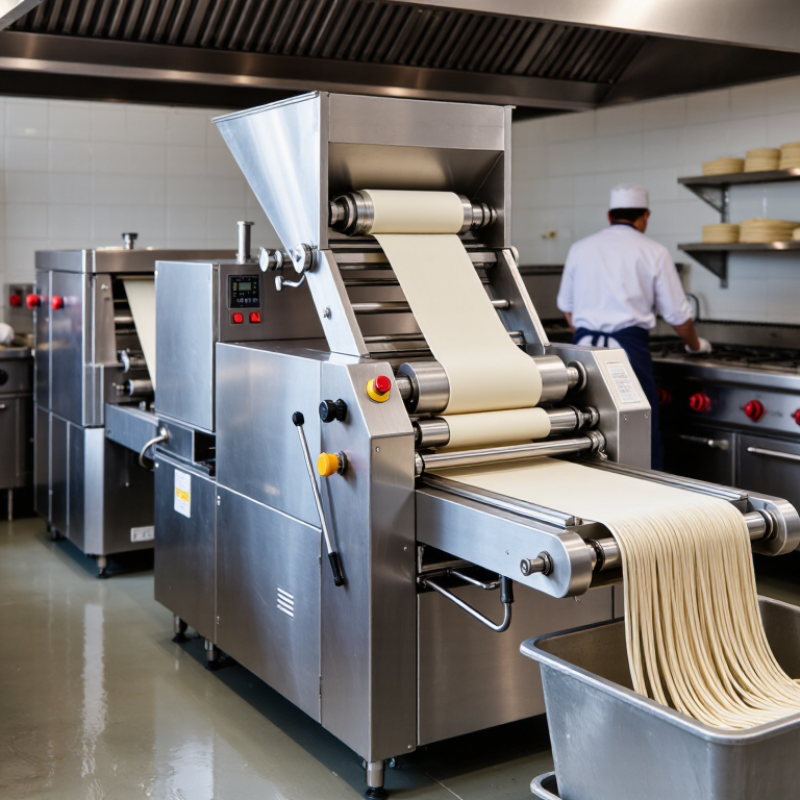
A sheeter gradually reduces dough thickness, often through several roller passes. Look for consistent adjustment and sturdy rollers; uneven sheets can produce noodles with different cooking times. A cutter then sets noodle width, such as broad strands for one menu or narrower strands for another. Changeover time matters when recipes vary. Complete production lines combine mixing, resting, sheeting, cutting, and conveying, reducing manual transfers but requiring more floor space and coordination. Measure the room before choosing one. It is easy to focus on hourly capacity and overlook maintenance access. Ask to see dough run at your intended hydration and thickness, then inspect the finished strands. A specification sheet cannot reveal every small inconsistency.

Best Udon Noodle Machine 2026 for Commercial Buyers - Udon Machine Types: Mixers, Sheeters, Cutters, and Complete Production Lines

Indicative equipment ranges for commercial planning. Actual throughput and specifications vary with dough formulation, noodle dimensions, operating conditions, and machine configuration; confirm them with the supplier before purchase.

Machine type Main function Typical commercial range Typical configuration Best fit Buyer checks
Dough mixer Combines flour, water, and salt into udon dough; some models provide staged mixing or vacuum mixing. About 20–100 kg of flour per batch for many commercial installations; batch size and cycle time differ by model. Horizontal or vertical mixing bowl; fixed or tilting discharge; stainless-steel food-contact surfaces are common. Foodservice suppliers and small-to-medium noodle plants that prepare dough in batches. Clarify whether rated capacity means flour or finished dough; check minimum batch size, water addition method, cleaning access, and cycle time.
Dough sheeter / roller Compresses dough through adjustable rollers, often in successive passes, to create a consistent sheet. Roller working widths commonly fall around 200–600 mm; sheet thickness is adjustable and machine-dependent. Single or paired rollers; manual or powered gap adjustment; standalone or conveyor-fed arrangements. Operations seeking repeatable sheet thickness before cutting or further rolling. Check usable roller width, adjustment range, dough feed method, guarding, and compatibility with the planned dough rest and rolling process.
Noodle cutter Slits a dough sheet into strands using a cutting roller or interchangeable cutter set. Available strand widths vary by cutter set; commercial options commonly cover several millimetres, including widths used for thick udon. Standalone or sheeter-mounted cutter; fixed or changeable cutting widths; manual or powered strand separation. Small and medium producers needing a defined noodle width and a relatively simple cutting stage. Confirm the exact cut width, tolerance, sheet-width compatibility, spare cutter availability, and ease of cleaning.
Integrated sheeter and cutter Rolls dough to the target sheet thickness and cuts it into strands in a connected machine or coordinated stages. Capacity depends on working width, feed rate, dough condition, and operator handling; request a product-specific test. Roller section, cutting section, drive system, and optional flour-dusting or conveyor features. Growing kitchens and smaller plants that want fewer separate handling steps. Evaluate changeover time, adjustment repeatability, operator access, cleaning procedure, and the full line’s bottleneck stage.
Complete udon production line Coordinates dough preparation, resting or conveying, rolling, cutting, and optional portioning or downstream handling. Configured to order; capacity must be assessed for the complete process rather than inferred from one component’s rating. Modular equipment with conveyors and controls; downstream cooking, cooling, or packing may be separate systems. Medium-to-large manufacturers seeking coordinated production and consistent batch-to-batch output. Request a throughput guarantee for the intended recipe and product; verify layout, utilities, sanitation design, staffing, and integration scope.

Commercial Output: Compare Rated kg/h with Batch Size and Peak Demand

A udon machine’s rated kg/h is only useful when matched to the kitchen’s busiest service window.

The National Restaurant Association’s 2025 State of the Restaurant Industry report projected US restaurant sales of $1.5 trillion, underscoring the scale of foodservice demand—not the capacity any single kitchen needs.

Build your estimate from actual orders: 40 kg of noodles required across a 90-minute peak means roughly 27 kg/h before allowing for loading, cleaning, or pauses. A 35 kg/h rating may look adequate on paper. Test it.

Batch size matters just as much.

If a machine produces 10 kg per batch, four batches cover that 40 kg requirement, but only if mixing and discharge fit the service schedule. Ask how rated output was measured: dough hydration, noodle thickness, and continuous operation can change real throughput.

Request a timed production trial using your own recipe, and record usable kilograms, not dough entering the machine. Leave capacity headroom for uneven demand.

A tidy spreadsheet can still mislead. A missed peak is harder to fix.

Dough and Cut Dimensions: Apply Japan’s 1.7 mm Dried-Noodle Benchmark

For a commercial udon noodle machine, specify dimensions at both the dough stage and after drying. Use 1.7 mm as a practical dried-noodle benchmark, then verify the exact product category against Japan’s Ministry of Agriculture, Forestry and Fisheries (MAFF) JAS materials. Do not assume the cutter’s dial equals the finished noodle thickness. Drying can change dimensions, so request trial runs using your own flour and target moisture level. Small difference. Big effect.

Ask suppliers to record dough-sheet thickness, cut width, finished thickness, and strand variation across a production run. A sample that looks uniform on the table may cook unevenly in a commercial pot. FAO’s Food Outlook (June 2024) estimated global wheat production at about 791 million tonnes, but that broad supply figure cannot predict how a specific flour lot will behave. Test more than one lot. It takes time, and I would not skip it. Check whether the machine holds its cut after extended operation, not only during a short showroom demonstration. Keep the test report with the purchase specification; otherwise, the 1.7 mm target can become a guess.

Best Udon Noodle Machine 2026 for Commercial Buyers

Dough and Cut Dimensions: Japan’s 1.7 mm Dried-Noodle Benchmark

The chart highlights the 1.7 mm dried-noodle reference benchmark. When evaluating a commercial machine, check that its cutter can produce the required width consistently, then verify finished noodles against the applicable product specification.

Food Safety: Assess ISO 22000:2018 Systems and Cleanable Food-Contact Parts

For commercial udon production, food safety starts with the machine’s design and daily cleaning routine. Ask whether the manufacturer operates an ISO 22000:2018 food safety management system, and request current, verifiable documentation. Certification can indicate a structured approach to hazard control, but it does not prove that every machine is easy to clean or suitable for your process.

Inspect the food-contact parts closely. Stainless steel surfaces should be smooth, with no rough seams or hard-to-reach corners where wet flour can collect. Check whether rollers, cutters, and dough guides can be removed or opened without awkward tools. A small crevice matters. Ask to see the cleaning instructions, then compare them with the machine itself. Do they explain how to reach the underside of a roller? Are seals accessible for inspection and replacement? These details affect whether staff can clean consistently between production runs. Paperwork helps, but it can feel reassuring too quickly. Watch a cleaning demonstration, review maintenance records, and confirm that the proposed cleaning method suits your facility’s procedures. A machine that is difficult to disassemble may turn a sound written plan into an uneven practice.

2026 Buying Criteria: Power, Footprint, Service, Warranty, and Cost per kg

For commercial udon production in 2026, compare machines by usable output, not the largest number on a brochure. Ask suppliers to run your flour blend, hydration level, and target noodle thickness. Record kilograms per hour over a steady shift, not just a short demonstration. Power matters. Check the machine’s rated draw and peak load against your kitchen supply, especially when mixers and cookers run at the same time. A smaller unit may suit a tight operation, but measure room for dough loading, cleaning, and repairs. Leave space behind it. Operators need access without moving half the kitchen.

Service can shape your real cost more than a small purchase-price difference. Ask how quickly technicians respond, which wear parts are stocked locally, and whether remote troubleshooting is available. Read the warranty carefully; rollers, belts, and damage from improper cleaning may be treated differently. Get the terms in writing. Estimate cost per kilogram using purchase price, expected output, labor, energy, cleaning time, waste, and downtime across the machine’s working life. Then compare that estimate with a production trial. The spreadsheet can mislead. I would still allow extra time for changeovers and imperfect dough batches; actual shifts rarely follow a neat calculation.